

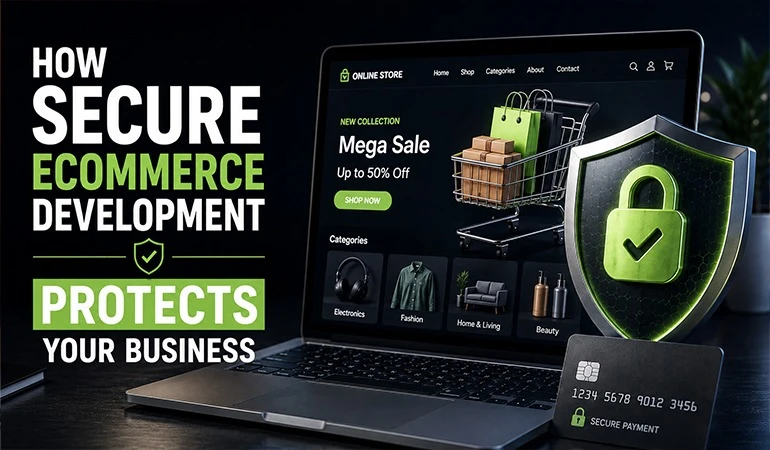
E-commerce is for everyone, not only big brands. Small businesses, startups & local companies are also selling their products and services online. However, as online businesses grow, so does the number of cyber threats.
If your e-commerce website isn't secure, it’s not just data theft that’s at risk of customer trust, brand reputation & your revenue could all be jeopardized.
That is why secure e-commerce development has become a top priority for every online business today.
Covalent Softwares develops e-commerce websites using modern security standards; these sites are not only fast and visually appealing but also offer robust protection against cyberattacks.
During online shopping, customers share various sensitive details, such as:
• Name and address
• Mobile number
• Email ID
• Bank or card details
• Online payment records
• Order history
If this information falls into the wrong hands, it can lead to significant losses for both the customer and the business.
An insecure website can expose you to several problems.
If customer data is leaked, customers may avoid shopping on your website in the future.
You could face heavy expenses due to hacking, fraudulent orders, payment fraud & data recovery costs.
If your website is hacked, Google may flag it as insecure, causing your search rankings to drop.
Even a minor lapse in online security can tarnish a reputation built over years.
A secure e-commerce website protects multiple levels.
SSL encrypts the data exchanged between the website and the customer, ensuring that information remains secure.
Reliable payment gateways ensure the security of customers' financial transactions.
Strong passwords and multi-factor authentication help prevent unauthorized logins.
Periodically updating websites, plugins & servers is essential for maintaining security.
Firewalls protect websites from external attacks by blocking suspicious activity.
Regular backups facilitate quick data recovery following technical issues or cyberattacks.
Continuous scanning identifies viruses or malicious code present on the website.
Customers shop without worry when they see a secure website, leading to increased repeat orders and higher customer satisfaction.
Secure payment systems significantly reduce fraudulent transactions and payment fraud.
Critical data belonging to both the customer and the company remains secure.
Security measures help keep the website operational, ensuring sales remain uninterrupted.
Implementing proper data security measures mitigates various legal and regulatory risks.
Search engines place greater trust in secure websites, increasing the likelihood of better rankings and organic traffic.
If you are looking for a secure, fast & future-ready e-commerce website, Covalent Softwares offers solutions tailored to your specific needs.
The company develops websites using modern security technologies, placing equal emphasis on both performance and security. Key Features:
• Custom E-commerce Development
• Secure Payment Integration
• SSL Implementation
• User Authentication System
• Fast Website Performance
• Mobile-Friendly Design
• SEO-Friendly Development
• Regular Security Updates
• Scalable Architecture
• Ongoing Technical Support
Every business should keep the following points in mind:
• Always use HTTPS.
• Adopt a strong password policy.
• Conduct regular security audits.
• Maintain regular website backups.
• Use only trusted plugins and extensions.
• Restrict admin access.
• Update software periodically.
• Store customer data in encrypted form.
• Monitor login activities.
• Choose a reliable development partner.
An online fashion store was receiving hundreds of orders daily. Due to inadequate website security, the store began facing numerous fraudulent orders and suspicious login attempts.
After implementing secure ecommerce development practices including SSL, secure logins, enhanced payment security & regular monitoring fraudulent activities decreased, customer trust increased & the order process became more secure.
An electronics retailer's website handled a large volume of online payments. The company was concerned about both customer data security and website availability.
After implementing secure server configurations, backup systems & firewalls, the website became more stable and secure. Customers continued shopping without issues & business operations ran smoothly.
A regional retail brand decided to upgrade its legacy e-commerce website to a secure platform. Features such as SSL, secure payment integration, admin access controls & regular security updates were implemented.
Within a few months, website stability improved, customer complaints decreased & customer trust during online shopping grew stronger. Additionally, positive changes were observed in the website's search engine performance.
A health and wellness company was growing rapidly, but customer data security was its top priority. Adopting secure e-commerce development practices, the company implemented data encryption, secure servers, regular backups & multi-factor authentication.
Consequently, the website became more secure, technical disruptions were minimized & customers began placing orders without security concerns. This also bolstered the company's online credibility.
Consider the following factors when selecting a development partner:
• Strong experience in security.
• Use of modern technologies.
• Provision of regular support and maintenance.
• SEO-friendly development practices.
• Expertise in secure payment integration.
• Ability to scale the website according to future needs.
• Provision of security updates and monitoring services.
Yes. Most businesses use a combination of Bulk SMS for critical notifications and RCS Messaging for interactive marketing.
Bulk SMS is considered the most reliable option for OTPs, transaction alerts & time-sensitive messages.
No. RCS works only on devices and networks that support this technology and have internet connectivity.
If the budget is limited and you need to send messages to a large number of customers, Bulk SMS is the more cost-effective option.
Yes. Features such as images, videos, catalogs, buttons & interactive elements in RCS drive higher customer engagement, which increases the likelihood of clicks, inquiries & sales.
