

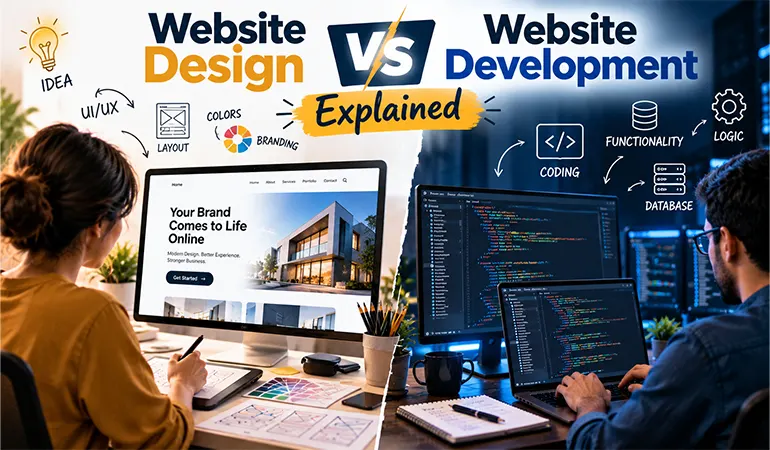
A business website is often the first place potential customers visit before deciding whether to trust a company. Its appearance, navigation, loading speed and functionality all influence how visitors experience the business.
However, creating a successful website involves two distinct areas of work: website design and website development. Although these terms are often used interchangeably, they serve different purposes and require different skills.
Covalent Softwares understands the importance of combining a well-planned visual experience with reliable website functionality. Understanding the difference between website design and website development can help businesses choose the right services and make better decisions when building or improving their websites.
Website design focuses on how a website looks, feels and guides visitors through its content. It involves planning the visual layout, selecting colours and fonts, arranging content and making sure visitors can navigate the website comfortably.
A website designer considers the needs of the target audience and creates an interface that communicates the brand's identity while making information easy to find.
A website designer may handle the following tasks:
• Visual layout: Planning the position of menus, images, headings, buttons and content sections.
• Colour and typography: Choosing colours and fonts that support the brand identity and readability.
• User experience (UX): Making the website simple to navigate and helping visitors complete important tasks.
• User interface (UI): Designing the interactive elements visitors see and use.
• Responsive design: Planning layouts that work across desktop computers, tablets and mobile phones.
• Wireframes and prototypes: Creating page structures and interactive previews before development begins.
A well-designed website helps visitors understand what a business offers without unnecessary effort. Clear navigation, readable text, consistent branding and visible calls to action make it easier for users to explore products and services.
Good design can also support business objectives. For example, a strategically placed enquiry button may help visitors contact a service provider, while a clear product layout can make an online store easier to use.
Poor design can cause confusion, reduce trust and discourage visitors from taking the next step.
Website development involves building the website's functionality and making its design work in a real browser. Developers use programming languages, frameworks, databases and other technologies to create the features visitors interact with.
Depending on the project, development may involve a simple business website, a content management system, an online store or a complex web application.
Website development commonly includes the following activities:
• Front-end development: Building the visible interface using technologies such as HTML, CSS and JavaScript.
• Back-end development: Creating server-side logic, processing requests and managing application functionality.
• Database management: Storing and retrieving information such as customer records, orders and product details.
• API integration: Connecting the website with payment gateways, CRM systems, messaging platforms and other services.
• Testing and debugging: Identifying errors and checking whether features work as expected.
• Security and performance: Applying suitable security measures and improving loading speed and reliability.
A website may look attractive in a design preview, but it still needs development to function correctly. Forms must submit information, navigation must work, products must be displayed and payment systems must process transactions securely.
Website development turns a visual plan into a working digital platform. It also determines how well the website handles different devices, user requests, integrations and future changes.
For businesses that need more than a basic online presence, development provides the technical foundation for growth.
Website design focuses on visual presentation and the user's experience. Website development focuses on building the technical structure and functionality that make the website work.
Designers may use tools such as Figma, Adobe XD and design features within other creative applications to prepare layouts and prototypes.
Developers commonly work with HTML, CSS, JavaScript, programming frameworks, databases, content management systems and development environments.
The exact tools depend on the project and the team's preferred workflow.
Website design requires visual judgement, layout planning, typography, user research and an understanding of user behaviour.
Website development requires programming knowledge, logical problem-solving, debugging, database skills and an understanding of web technologies.
Both roles benefit from communication skills and a clear understanding of business requirements.
A designer may deliver wireframes, page layouts, design systems and interactive prototypes.
A developer delivers the working website, including its page templates, forms, integrations, content management features and other required functionality.
These deliverables often overlap when a professional or agency offers both services.
Website design influences how visitors perceive the brand, find information and move through the website.
Website development influences functionality, technical performance, security and the ability to support business processes.
Both can affect conversions and customer satisfaction. Neither should be treated as an isolated task.
Design and development are closely connected throughout a website project. The design establishes the intended experience, while development implements it using suitable technologies.
A typical workflow includes:
• Step 1: Requirement gathering: Understand the business, target audience, website goals and required features.
• Step 2: Planning: Define the site structure, page hierarchy, navigation and content requirements.
• Step 3: Design: Prepare wireframes, visual layouts and prototypes.
• Step 4: Development: Build the interface, server-side functionality and integrations.
• Step 5: Testing: Check usability, mobile responsiveness, forms, browser compatibility, security and performance.
• Step 6: Launch and maintenance: Publish the website, monitor its behaviour and address technical or content issues.
Early communication between designers and developers reduces misunderstandings and helps prevent costly changes later.
Businesses may need design services for:
• Corporate and business websites.
• E-commerce storefronts.
• Landing pages for marketing campaigns.
• Portfolio and personal websites.
• Website redesigns and interface improvements.
Development requirements may include:
• Custom website development.
• WordPress and other CMS-based websites.
• E-commerce functionality and payment integration.
• Customer portals and web applications.
• CRM, booking and third-party system integration.
• Website maintenance, security updates and performance improvements.
Covalent Softwares can be considered when a business needs website design and development support aligned with its goals, required features and long-term plans.
The right choice depends on the problem you want to solve.
If your website looks outdated, has confusing navigation or does not communicate your services clearly, design improvements may be the first priority.
If the website has broken forms, slow database operations, limited functionality or integration problems, development work may be more urgent.
Many businesses benefit from both services because appearance, usability and technical performance contribute to the overall website experience.
A local service provider wants a website to attract customers and receive enquiries. The design team creates a clean homepage, service pages, customer testimonials and prominent contact buttons.
The development team builds the pages, integrates an enquiry form and ensures the website works on mobile devices. Analytics can then help the business understand which pages generate enquiries.
Business benefit: A clear website experience supported by working contact features can make it easier for potential customers to reach the business.
An online retailer needs a website where customers can browse products, add items to a cart, make payments and track orders.
The designer plans product pages, category layouts and the checkout experience. Developers build the product catalogue, cart functionality, payment integration and order management features.
Business benefit: A coordinated design and development process helps create a shopping experience that is easier to navigate and manage.
The following are illustrative scenarios, not verified client projects.
Challenge: A consulting firm has an outdated website with unclear service descriptions and a difficult navigation structure.
Solution: The design team reorganises the website, improves typography, creates consistent service pages and makes enquiry buttons easier to find. Developers implement the revised layouts and test mobile usability and form submissions.
Expected outcome: Visitors can understand the firm's services more easily, while the business gains a clearer path for enquiries. Performance should be assessed using form submissions, engagement data and user feedback.
Challenge: An online store has a confusing product catalogue and a checkout process that requires unnecessary steps.
Solution: Designers simplify category navigation and improve product page layouts. Developers streamline cart functionality, check payment integration and test the checkout process across different devices.
Expected outcome: The store may become easier to use, with fewer obstacles during checkout. Changes in conversion rates and abandoned carts should be measured before claiming a business improvement.
Website design focuses on the website's appearance, layout, navigation and user experience. Website development focuses on coding and implementing the functionality that makes the website work. Both contribute to the finished product.
Yes. Some professionals have skills in both design and development. They may create visual layouts, write front-end code and build websites using content management systems. Complex projects may require separate specialists.
Both are important. Good design helps visitors understand and navigate the website, while good development ensures that its features work correctly. The right balance depends on the website's purpose and business requirements.
A design alone is generally insufficient for launching a complete website. The design must be implemented, the content added and the required features tested. Some website builders combine design and technical functions, but the underlying setup and checks are still necessary.
The cost depends on the number of pages, design complexity, required functionality, integrations, content needs and maintenance arrangements. A basic business website generally requires less work than a custom web application or a large e-commerce platform.
